

What this is
This article explains how The National Socialist American Party’s economic program would work in everyday life.
Interest-free credit for production, prices built from real costs, and wages a family can live on — none of that happens by passing a law and walking away. It takes an institution that knows what each trade produces, what it costs to operate, what skills it requires, and what its workers need to earn. In our political framework, that institution is The National Worker Guild.
Capitalism hands the decisions of prices, wages, and credit to private finance and calls the result a “free market”.
Communism responds with class conflict, the end of private entities, and forced equality, which leads to (at best) a soulless ant colony.
Both ideologies overlook the fundamental unit that drives a Nation: its people.
Our political and economic framework is fiercely dedicated to empowering our folk with life’s essentials, enabling them to live, work, innovate, and shape their own destinies within a civilization that is both thriving and secure. The National Worker’s Guild stands as a guiding pillar, to ensure our economy remains robust and sustainable, so our people not only survive but flourish.
Four critical tasks of our system
1.) Prices should reflect production cost, not speculation. They should be built from the cost of materials, labor, overhead, and the rightful margin earned by the business owner. Not a markup collected by someone who never touched it.
2.) A week’s work should cover a week’s living. Food, rent, heat, home maintenance, and some leisure time — without a credit card closing the gap at twenty-four percent.
3.) Credit should reach the people who build things. The shop that needs a drill press. The farm that needs a harvest season. Not a fund buying all the real estate or a billionaire who needs a new yacht.
4.) Cost facts should be built from the ground up. The baker knows what flour costs, what gas costs, what it costs to keep a second man on at five in the morning. That number should reach you straight, not through a lender with profits to protect.
Know what we’re against
We are not against profit. A man who buys steel, pays four machinists, and sells a finished part for more than it cost him earned every dollar of that difference. He made something that didn’t exist that morning. That’s the engine of a working country and we intend to protect it. Without profit a business can’t grow, can’t hire, and can’t survive a bad year.
We’re against the money taken by people who make nothing. The fund that buys your landlord’s building and doubles the rent. The bank whose interest is in the price of the part before a single cut is made. The firm that buys your competitor and shuts the line down.
We are against the profits “earned” through exploitative measures, such as charging interest on loans, stock market manipulation, predatory real estate practices, price gouging, profiteering, and monopolistic business tactics.
The current system was built to collect claims, and it collects them well. The American economy is designed for one end goal: endless profits for the few at the expense of the many.
The failure of our economy runs back to one decision nobody voted on: who gets to create money, and what they charge for creating it.
Money enters this economy as debt with interest attached. That makes interest a cost of production — it’s in the bread, the rent, and the bill the hospital sends you. You pay it even if you’ve never borrowed a dollar in your life. And you pay it to people who produced nothing, moved nothing, and built nothing. A bank creates that money by typing it into an account, then charges the country rent on it.
So we take it back.
The Federal Reserve is replaced by a national bank. That bank issues the nation’s money and extends credit for approved production at no interest.
In our new economy, charging interest rates must become a serious crime to the Nation! Money under our system is a receipt for production, not a private loan to bring someone unearned profits.
Bread gets cheaper because flour got cheaper, because the mill’s loan got cheaper. The taxes that were used to pay off government debt to the banks goes away. The baker’s margin doesn’t shrink — it’s the first full margin he’s had in thirty years, because he’s keeping it instead of handing it to a bank.
How The Guild is built
The National Worker’s Guild is one public body for every trade, holding everyone in it — from the kid sweeping up the floors, to the man whose name is on the door. The guild certifies training. It publishes what the trade costs to run. It sets the wage floor for the sector. And when a business applies for production credit, the guild is the body that says whether the plan is real: whether the shop has the floor space, the materials, and the trained men to do what it says it will do.
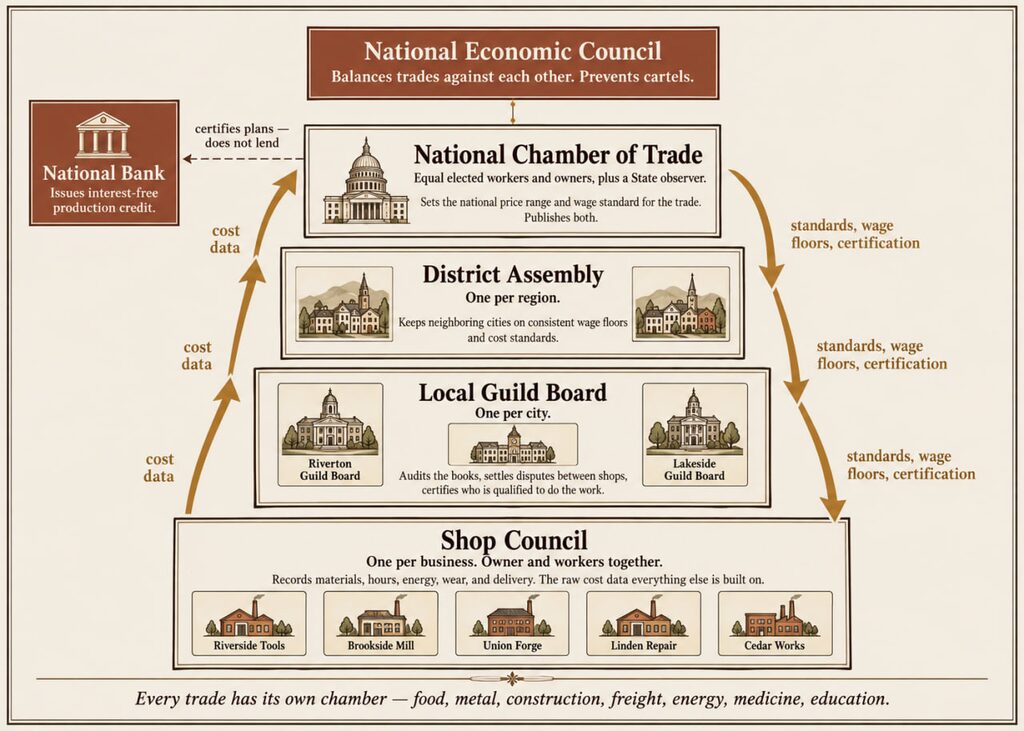
Our model for this guild has 4 levels, built from the ground up:
The shop council. Every business has one, and it seats the owner and the men who work there. The council keeps the record: what was bought, what was sold, hours worked, energy burned, wear on the equipment, what it cost to get goods out the door. These are the numbers the whole system runs on. Right now that paperwork exists to satisfy a tax collector and everybody treats it accordingly. Here it’s the measure of the trade, and it’s kept by the people who actually know.
The local guild board. Sits over the shops in a city. It audits the books, settles fights between shops, and says who’s qualified to do the work and who still needs training. When a shop’s numbers don’t add up, this is where it gets caught first, by men who know what the work costs because they do it.
The district assembly. Covers a region. Its job is keeping neighboring cities in line with each other, so a shop forty miles down the road isn’t working off a different wage floor or a different cost sheet. Without it, every corridor in the country turns into a race between two towns to see who’ll work cheaper.
The national chamber of trade. Equal numbers of elected workers and elected owners, with a State observer in the room. The chamber sets the national price range and the wage standard for the trade, and publishes both. The observer isn’t there to run the trade — the men in the trade know it better than any official will. He’s there so the chamber can never quietly become a club that exists to serve itself at the country’s expense.
Every sector has this structure. Food, metal, construction, freight, energy, education, medicine, law. Each one gets its own chamber, because what a machinist needs and what a nurse needs are not the same thing and never will be.
Agriculture is treated as the estate of food security. Growers, packers, and the land trades sit together, and seed, fuel, and water are kept out of the reach of speculation entirely. A country that lets traders set the price of its food is a country that has agreed to go hungry on somebody else’s schedule.
How a price gets built
Every guild covers one link in the chain, and each one’s price becomes the next one’s cost.
Start at the bottom. The raw materials guild handles what comes out of the ground — ore, salt, timber, seed. It works out what those things cost to extract and get to market, and publishes it. That’s the floor the whole economy stands on, so it’s the number that has to be honest first.
The farmers guild takes those numbers and builds on them. It knows what seed costs, because the guild below it published that. Add fuel, equipment, the note on the land, and the wages a man needs to raise a family on that ground. Now the guild knows what it costs to grow an acre of corn.
The farmer sells his corn above that, and the difference is his. He earned it. The guild isn’t setting his profit — it’s making sure the price he needs to charge is built from real costs instead of what a trader in Chicago decided corn should be worth this week.
Then the mill buys that corn and the process repeats. The miller’s guild knows what the corn cost, because the farmers published it. The baker’s guild knows what the flour cost. All the way up to the loaf on the shelf.
Right now, today in the United States nobody in that chain knows what anything costs. The farmer doesn’t know what his corn is worth; he finds out when the buyer tells him. The baker doesn’t know why flour jumped; he just pays it. Every link is negotiating blind against somebody who can see the whole board.
Under this system the numbers are open at every step. A man can see what went into his inputs and account for what he adds. The price on the shelf traces back down the chain to real costs and real wages, every link of it.
And each guild watches its own trade. The farmer’s guild doesn’t let a farmhand’s wage get bargained down to nothing, because farmers sit on that board and they know what the work takes. The raw materials guild doesn’t let ore get priced on speculation, because the men pulling it out of the ground know what pulling it out of the ground costs.
That’s the fourth thing on our list, and it’s the one nobody talks about: the man who pays the cost should be the one who reports it.
Wages
If the price of a good is built from what it costs to produce, the wage can’t be left to whoever has the most leverage in the room.
The chamber sets the floor for the trade, and it starts from a real number: what it costs to feed, house, heat, and clothe a family in that line of work. A full week’s work has to clear that. A household covering groceries with a credit card isn’t a household with a budgeting problem. It’s a wage that was set below the cost of living and a country pretending not to notice.
Above the floor, pay follows the work — skill, responsibility, years in the trade, what the job demands. An engineer and a farmhand are not doing the same thing and won’t be paid the same. That’s fine.
What isn’t fine is the spread we have now, where one necessary trade lives comfortably and another necessary trade can’t cover a dental bill. When the country can’t function without both, and only one of them can live, that’s not a market outcome. That’s a failure, and the chambers are there to catch it.
Wage floors get coordinated across trades, so the sectors don’t drift apart, and regional differences stay in the numbers where they belong. Fuel, freight, and climate really are different in Texas and Maine. That’s a fact about costs, not a license to run two different economies.
What gets enforced, and how
The guild sets standards. The law does the punishing. Those stay separate, so no man ever sits on a board that can both set his competitor’s wages and destroy his competitor.
Getting in. You earn your place in a trade by training in it, doing the work, and taking on the duties that come with it: keep honest books, do quality work, and train apprentices so the skill survives you. No shells, no paper companies, no outfit that exists for a season and disappears.
Keeping it. Disputes get worked out inside the estate first, between men who know the trade, before anybody goes to court over it.
Breaking it. Padding costs, hiding labor, or pocketing money that was issued for production isn’t clever business. Those numbers are what the whole system uses to set prices and issue credit. Falsify them and you’re not beating a competitor, you’re raising the price of food or fuel or housing for every household that buys what your trade makes. The farmer pays it, the baker pays it, and the family at the grocery store pays it last and hardest.
So: pay under the wage floor and you repay every dollar you shorted your men, with penalties. Do it twice and you lose your charter. Falsify your books and you owe restitution down the whole chain, and you can lose the right to practice the trade. Move the work overseas to undercut American wages and the goods come back tariffed until there was no point in leaving. Lend at interest and you go to a labor camp to repay what you stole.
When a whole guild lies. Every published cost figure carries the names of the board members who certified it. That’s the point of publishing. The guild buying from them sees that number, and so does everyone else in the chain. A miller who’s bought corn for thirty years knows what growing it costs, and when the published figure doesn’t match what the men in the field are actually paying, he says so in the open.
The national body rules on it. If the figure was padded, the guild loses certification, the board is dissolved, the men who signed the number are barred from any guild board for life, and the trade seats a new board before it can certify anything again.
Nobody signs a number he can’t defend. That’s the deterrent, and it works because the man who’d catch him is the man buying from him.
What stays private, and what doesn’t
Ordinary productive property stays in private hands and passes to your heirs: the house, the family farm, the independent shop. That ownership is the basis of membership in an estate. A man with something to lose and something to leave behind builds differently than a man managing an asset for somebody in another state.
Foreign ownership of American land and housing ends. A house is where the workforce lives. It is not a position to be held.
Speculative landlordism is restricted for the same reason. Housing that exists to be leveraged rather than lived in takes the roof out from under people who work for a living and hands it to whoever can wait longest.
Concentration gets addressed when it’s used to corner a trade or to beat wages down with the threat of moving. A big plant stays big when the work requires it — some things can only be built at scale, and we’re not going to pretend otherwise. Size is not the offense. Using size to dictate terms to the country is.
Water, power generation and distribution, main transport, basic extraction, and strategic materials are publicly owned. Every trade in America builds its costs on top of those four or five inputs. If power is run as a financial asset, then the bakery and the machine shop are paying somebody’s return before they’ve made anything, and no amount of guild bookkeeping downstream will fix it.
Taxes
Most of them go away, and this is the part nobody expects.
Right now a large share of federal revenue exists to pay interest to bondholders on money that was created out of nothing. Remove the interest and you remove the reason for the tax.
Taxation stops being how the government funds itself and becomes what it should have been: a way to pull money back out of circulation when there’s too much of it, and to charge for scarce resources and public utilities.
Taxes on productive wages, on the family home, on the ordinary inheritance of a working business, and on productive surplus are artifacts of the debt system we’re replacing. They go.
What remains is a straightforward national tax on consumption/sales. This deletes the money from circulation to stabilize the amount of money in circulation and retains the currency’s value without punishing the man who earned it by making something.
The council that keeps the guilds honest with each other
Above the guilds sits the National Economic Council, and its job is making sure the estates don’t turn into cartels.
Left alone, every trade will protect its own prices, and it will do it at the expense of the trade next door. The council balances them — food against freight, metal against education, energy against consumer goods. It watches for the things a single trade can’t see: a bad harvest, a rail line down, a skill that’s about to be needed in numbers nobody planned for.
With it, the trades work as parts of one production system. Without it, you’d have twenty guilds each defending its own margin and no one accountable for whether the country can feed itself.
International trade runs on the same principle. Finished goods we don’t need for survival can be traded for materials we do need. What we don’t do is send capital abroad to chase returns, and we don’t ask an American trade to cut its own throat because wages are lower somewhere else. Food, energy, core manufacturing, and transport are matters of policy, not line items to be optimized away.
What it comes to
A corporation exists to collect claims and limit liability. That’s not an accusation. It’s the legal purpose, written down, and it fulfills it faithfully. Stop expecting loyalty from something chartered to have none.
A guild exists to keep a trade alive: to know what the work costs, who can do it, and how much of it this country can turn out next year when we need it.
Put together, the program is five things:
- The nation issues its own money instead of renting it.
- Production credit carries no interest, which pulls the toll out of every price in the country.
- Ordinary productive property stays private, and stays yours.
- The essentials every trade depends on — power, water, transport, basic materials — are publicly owned, so costs start from a stable floor.
- The trades govern their own standards, in the open, with published numbers.
Without the estates (National Workers Guild) and without the issuance of interest-free credit, our economy remains nothing more than an extraction pool for Big Capitalists and the powers of High Finance, who dominate our world with endless profits accumulated through interest-bearing loans.
We believe that serving the needs of the Nation comes before the interests of the individual. Therefore, no individual should be able to manipulate our society, with the spirit of materialism, in order to collect more profit for himself at the expense of others!
In our economic framework, workers remain as the top priority— they are not merely cost factors or voting blocs, but integral members of an organized trade within a unified National economy.
The shop remains a shop, the farm remains a farm, the trade evolves into a public estate, and money is issued for production and retired against production. Those who create, cultivate, and construct are coordinated as active contributors to the nation. Those who do not work, do not get to extract our wealth.
This is the order we are striving to establish. Help us turn this vision into reality by supporting / joining our Party today.
Leave a Reply